• Home
  • About
  • Book a Virtual Session
  • Events
  • Ad Libitum Blog

The Improvisation Lab

  • Home
  • About
  • Book a Virtual Session
  • Events
  • Ad Libitum Blog

Ad Libitum Blog

Thirty Days, Thirty Improvisations: Introducing The Automatic Playing Project 

I’m excited to share something new with you: The Automatic Playing Project, a collection of experiments in free piano improvisation.

The idea

For thirty consecutive days, I sat down at the piano and improvised for ten minutes, with no plan, no script, and as little editing of myself as I could manage. The result is thirty performances, thirty days, and thirty attempts to listen beyond intention.

I should be upfront that this isn’t a collection of compositions in the traditional sense. It’s more like a diary in sound.

Where the title comes from

“Automatic playing” is a musical cousin of automatic writing. The idea goes back to Gertrude Stein’s psychological experiments at Bryn Mawr College, which were shaped by William James’ thinking about consciousness, habit, and attention. Stein explored whether actions could arise outside our deliberate control. I wanted to ask the same question at the keyboard: what happens when I suspend judgment, planning, and self-censorship? What music appears when the conscious “author” loosens its grip?

I was also thinking about a wider family of practices that try to get around ordinary control: psychoanalytic free association, spirit-medium writing, and glossolalia, where language becomes pure sound. In each, the person is both participant and witness, watching material arrive rather than building it to a plan.

What it sounds like

At the piano, these ideas become physical. My hands move before my analytical mind can step in. Gestures multiply, dissolve, repeat, and change. Some passages feel purposeful, and others feel like happy accidents. A bit of lyricism might surface and then get abandoned. Rhythms appear, fall apart, and regroup. I spent the month living on the line between playing the instrument and being carried along by the act of playing.

I don’t claim these recordings reveal some pure, unfiltered unconscious. Every performance carries traces of memory, habit, training, mood, fatigue, curiosity, and whatever else was happening that day. If the unconscious shows up at all, it arrives tangled up with everything else. What you can hear is the process itself: a musician stepping into uncertainty and letting it shape the music.

How to listen

Each ten-minute piece stands on its own as a self-contained event. But if you listen in sequence, the thirty improvisations start to read like pages in a journal or entries in a laboratory notebook. Patterns pop up unexpectedly across days, some textures stick around, and others vanish. You’ll hear a relationship developing between me, the piano, and the process.

My invitation is simple: listen without expecting a destination. Treat the music less as finished statements and more as an experiment in attention and a study of how things emerge. Listen for the mysterious space between intention and instinct, where thought, gesture, memory, and chance briefly meet, and where, for a month at least, playing learned to play itself.

Listen now

You can hear the whole project on my YouTube Music channel, or your favorite streaming platform. I’d love to hear which days speak to you, so please drop me a note at drmatthewgiobbi@musepsyche.com.

Thank you for listening, and for being curious with me.

Warmly,
Matthew Giobbi
The Improvisation Lab, Nazareth, Pennsylvania

11/20/2026

  • Leave a comment
  • Share
    Thirty Days, Thirty Improvisations: Introducing The Automatic Playing Project

    Share link

in Improvisational music

Schoenberg on Character and Mood 

Listen at the Ad Libitum Podcast

“The concept that music expresses something is generally accepted. However, chess does not tell stories. Mathematics does not evoke emotions. Similarly, from the viewpoint of pure aesthetics, music does not express the extramusical.”

So opens Arnold Schoenberg in Chapter X, Character and Mood of his textbook, Fundamentals of Musical Composition.

Schoenberg continues, "But from the viewpoint of psychology, our capacity for mental and emotional associations is as unlimited as our capacity for repudiating them is limited. Thus every ordinary object can provoke musical associations, and, conversely, music can evoke associations with extramusical objects.”

Schoenberg begins by evoking two notions, fuelled by the academic psychology of the day -behaviorism. First is the behaviorist doctrine of associationism, or classical conditioning. The belief that all meaning is based on paired associations. The second concept suggests the widely held belief by behaviorists that we are marionettes to a complex architecture of conditioned responses, living within the illusion of freedom of choice.

“Many composers have composed under the urge to express emotional associations. Moreover, program music goes so far as to narrate entire stories with musical symbols. There aslo exist a great variety of ‘characteristic pieces’ expressing very conceivable mood.”

Schoenberg goes on to express his view that composers historically have used association or pairing of stimuli to knot a character to a musical impression.

“The term, character, applied to music, refers not only to the emotion which the piece should produce, and the mood in which it was composed, but also the manner in which it must be played. It is fallacious to think that the tempo indications determine the character. In classical music, at least, this is not true. There is not one adagio character, but hundreds; not one scherzo character, but thousands. An adagio is slow; an allegro is fast. This contributes something, but not everything, to the expression of a character.”

Here, Schoenberg uses terms more common outside of behaviorism, such as emotion and mood. Considered biologically driven. Unlearned states that motivate our actions, such as hunger and thirst, emotions, and a more general mood, are explanations we give ourselves to understand our actions. Tempo, or speed of the pulse, is not the only indicator of the emotional character of a piece of music; the associations are far more complex than the pace of the musical momentum. The psychological school of thought that dominated the period in which Schoenberg lived, both in Vienna and in Los Angeles, where he spent his life, was behaviorism, and the more one studies Schoenberg’s philosophy of music, the more one sees how behavioral psychology influenced his ideas.

Schoenberg goes on to describe the associations that have been culturally established from the earliest composers of the “classical” tradition to Romanticism. He emphasizes a key component of musical mood to be contrast between tempi, rhythms, and meter. Contrast is a main principle in Gestalt research psychology, which is much more philosophically sophisticated than the more popular behaviorism. “There is no single case,” Schoenberg states. “All good music consists of many contrasting ideas. An idea achieves distinctness and validity in contrast with others. Heraclitus called contrast, ‘the principle of development’. Musical thinking is subject to the same dialectic as all other thinking.”

Schoenberg observes that different forms indicate specific character. He says, “But, in general, light, graceful, simple moods will not require complicated forms nor adventurous elaboration. On the other hand, profound ideas, deeply moving emotions, heroic attitudes, require the bold contrasts and thorough elaboration of more complex forms.”

The main emphasis Schoenberg expresses is the link between tempo, rhythm, and meter and the mood that is often depicted visually. He says this is as true for a ballet as it is for film music. He concludes, “In composing even the smallest exercise, the student should never fail to keep in mind a special character. A poem, a story, a play or a moving picture may provide the stimulus to express definite moods. The pieces which he composes should differ widely. Especially fruitful are differences in tempo, rhythm and metre. Such practice will help him to acquire the capacity to produce the manifold types of contrast necessary for larger forms.”

Schoenberg’s overall project was iconoclastic. He wrote and composed with a strong belief that emotional meaning in music, as well as what is pleasing or displeasing to the ear, is largely culturally determined by associations which have become social conventions. He believed that, given a generation of atonal music, the social conventions would shift and the syntax of musical grammar with it. This dream only went so far, and in the years ahead we found that there is only so much wiggle room available for what any given individual will be drawn to find pleasure in listening to. In fact, the emphasis becomes less about the one-sided aesthetic question of the work or art, expanding to the psychological intentions and interests of the individual listener. 


11/09/2026

  • Leave a comment
  • Share
    Schoenberg on Character and Mood

    Share link

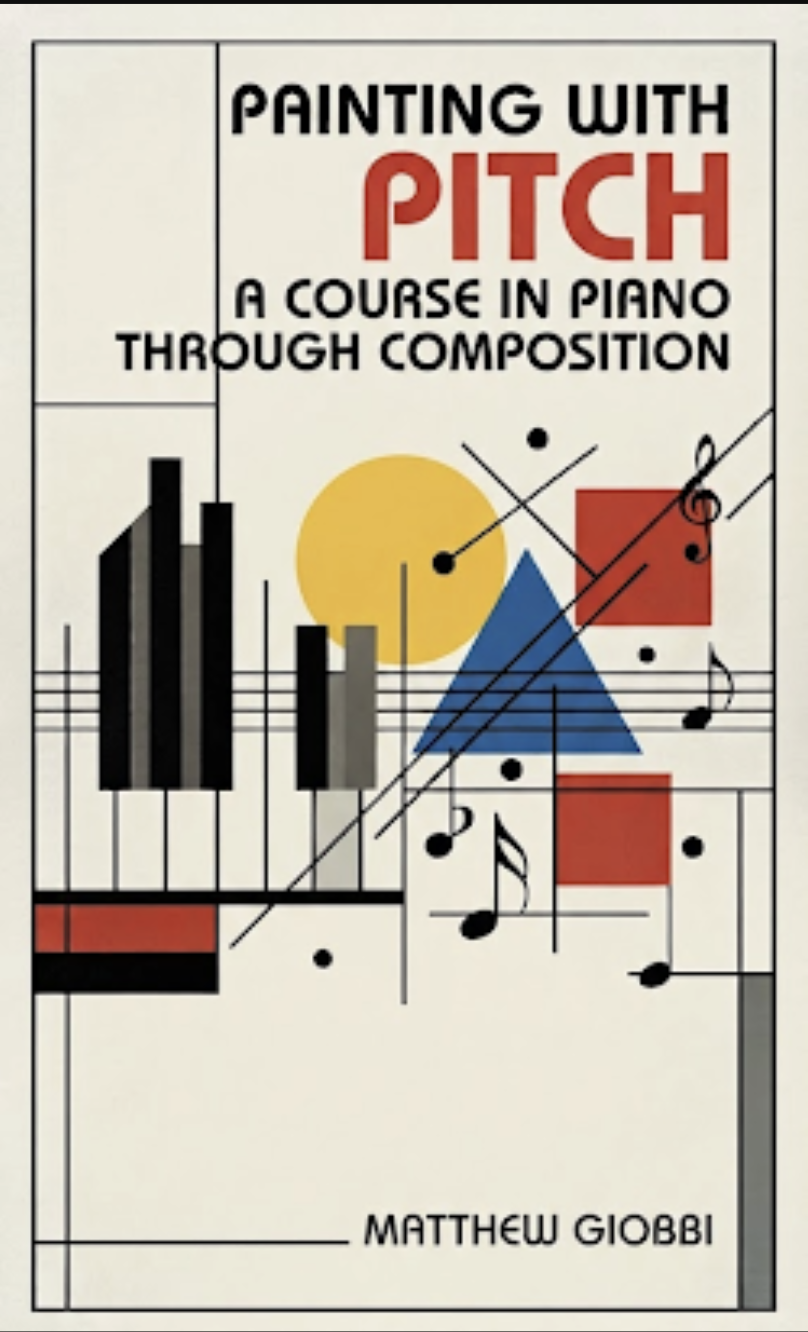
Painting With Pitch: Discover the Piano as an Instrument of Creativity 

Painting With Pitch: Discover the Piano as an Instrument of Creativity

What if learning to play the piano were not simply about reproducing music, but about discovering how to create it?


Imagine approaching the piano not as a student trying to master a collection of difficult pieces, but as an artist standing before a blank canvas. The keys become your palette. Notes become colors. Rhythm creates movement. Harmony establishes depth, tension, and resolution. And gradually, through experimentation and discovery, you begin to develop your own musical voice.

This is the inspiration behind Painting With Pitch: A Course in Piano Through Composition, an approach to learning piano that invites you to become not only a performer, but also a composer.

Learn music by creating music

Traditional piano instruction often begins with the music of other composers. Students learn to read notation, practice exercises, and reproduce pieces as accurately as possible. These are valuable skills, but there is another way to approach the instrument: begin with the creative act itself.

What happens when you place two notes together? How does a melody change when you alter its rhythm? Why does one chord seem to create a feeling of rest while another invites movement? What happens when you abandon familiar harmonic patterns and explore unfamiliar musical possibilities?

These questions transform piano study into an adventure.

In Painting With Pitch, the student explores the fundamental elements of music by composing. Reading, technique, ear training, theory, analysis, and performance are integrated into a creative process. Instead of treating musical knowledge as a collection of facts to memorize, the course encourages students to discover how musical ideas work by putting them into practice.

The goal is not simply to learn about music. It is to learn to think musically.

The piano as a canvas

A painter learns about color by mixing pigments, observing contrasts, and experimenting with the relationships between shapes. A musician can approach sound in much the same way.

A major scale offers one kind of musical landscape; a minor scale offers another. A chromatic interval can introduce surprise or ambiguity. A modal progression can open a space that feels suspended outside the familiar pull of conventional harmony. Rhythm can make a simple musical idea feel playful, meditative, dramatic, or expansive.

Through composition, these possibilities become experiences rather than abstractions.

You might begin with a few notes, arrange them into a small melodic figure, and discover a rhythm that gives them life. You might place a melody over different chords and notice how its emotional character changes. You might experiment with major and minor modes, explore modulation, or create a piece using principles of counterpoint.

There is no need to begin with a masterpiece. The important thing is to begin creating.

Each small experiment develops musical understanding while encouraging curiosity, imagination, and independence.

From musical foundations to improvisation

Painting With Pitch offers a systematic journey through the language of music. Its lessons explore the architecture of the keyboard and the hands, the nature of music, rhythm, intervals, scales, harmony, phrasing, modulation, modes, musical form, and counterpoint.

The course also ventures into improvisation, composition software, the study of other composers' music, and Gestalt visual thinking as a way of understanding musical composition.

These subjects are connected by a common principle: musical knowledge becomes more meaningful when you use it to make something of your own.

Learning harmony, for example, becomes more than identifying chords on a page. You begin to hear the possibilities contained within them. Studying form becomes more than memorizing formal structures. You discover how musical ideas can develop, contrast, return, and transform. Learning to improvise becomes an opportunity to bring your understanding of rhythm, melody, harmony, and expression together in the present moment.

The result is a more integrated relationship with music—one in which thinking, listening, feeling, and creating work together.

Creativity is not reserved for a select few

Many people believe that composition belongs to a special class of musicians: the gifted, the formally trained, or those who somehow possess an innate ability to invent melodies.

But creativity can also be understood as a practice. It grows through attention, experimentation, reflection, and the willingness to explore possibilities without knowing exactly where they will lead.

You do not need to wait until you have mastered every scale or learned hundreds of pieces before you begin composing. You can start with what you know, however little that may be.

A single note can become a musical idea. Two notes can create a relationship. A simple pattern can become a phrase. A phrase can develop into a piece.

The process is both educational and personal. As you learn to make musical decisions, you also develop confidence in your capacity to explore, make mistakes, recognize possibilities, and discover solutions.

This is one of the central motivations behind Painting With Pitch: to place creativity at the heart of musical education rather than treating it as an optional activity reserved for advanced students.

Learn at the pace of discovery

Music cannot always be understood on a fixed schedule. One idea may become clear in a single afternoon; another may require days or weeks of playing, listening, and reflection.

For this reason, the course is designed to be explored at the student's own pace. It can be used for independent study or as a systematic resource for piano teachers who want to incorporate composition into their teaching.

Self-study offers the freedom to linger over a musical question, repeat an experiment, and follow an unexpected discovery. Working with a teacher can provide additional guidance, feedback, and encouragement.

Whichever path you choose, the invitation is the same: approach the piano with curiosity and allow the process of creating music to guide your learning.

A different relationship with the instrument

The piano can be much more than a machine for reproducing written notes. It can become a place to investigate sound, develop ideas, explore emotion, and discover new ways of thinking.

When you compose, you begin to listen differently. You notice relationships between notes, the character of different harmonies, the shape of phrases, and the expressive possibilities of silence. You begin to understand music from the inside—not only as something created by others, but as a living language in which you can participate.

And perhaps most importantly, you give yourself permission to experiment.

You do not have to be a professional composer to enjoy composing. You do not have to be an advanced pianist to begin exploring musical ideas. You need only a willingness to sit at the instrument, listen attentively, and discover what happens when you begin to create.

The piano becomes your canvas. Sound becomes your medium. Music becomes a practice of discovery.

Begin your creative journey

Painting With Pitch: A Course in Piano Through Composition is an evolving educational project developed through decades of piano teaching. Its purpose is to bring together the practical skills of piano study with the imaginative possibilities of composition, offering a fresh perspective on what it means to learn music.

If you are a beginning pianist, an experienced player looking for a more creative approach, or a music teacher interested in bringing composition into your lessons, you are invited to explore the course.

You don't have to wait until you know everything about music to begin creating it. Start with a note. Add another. Listen. Experiment. Discover.

Let the piano become a place where you learn not only to play music, but to imagine it.

Explore Painting With Pitch: A Course in Piano Through Composition at Muse & Psyche.

Develop your musical imagination. Discover the art of thinking in sound.

10/25/2026

  • Leave a comment
  • Share
    Painting With Pitch: Discover the Piano as an Instrument of Creativity

    Share link

Books
Music
Ad Libitum Blog
Psychology Today Blog
Tuition
Payment & Tips

Contact:

Email: drmatthewgiobbi@musepsyche.com

Tel: 610-751-1742


Piano, Trombone, Musicianship, & Music Composition Lessons

Broadcasting from Nazareth, Pennsylvania, U.S.A.

Copyright 2026 by Matthew Giobbi.

Muse & Psyche, LLC

Some images ©

  • Log out
Powered by Bandzoogle