

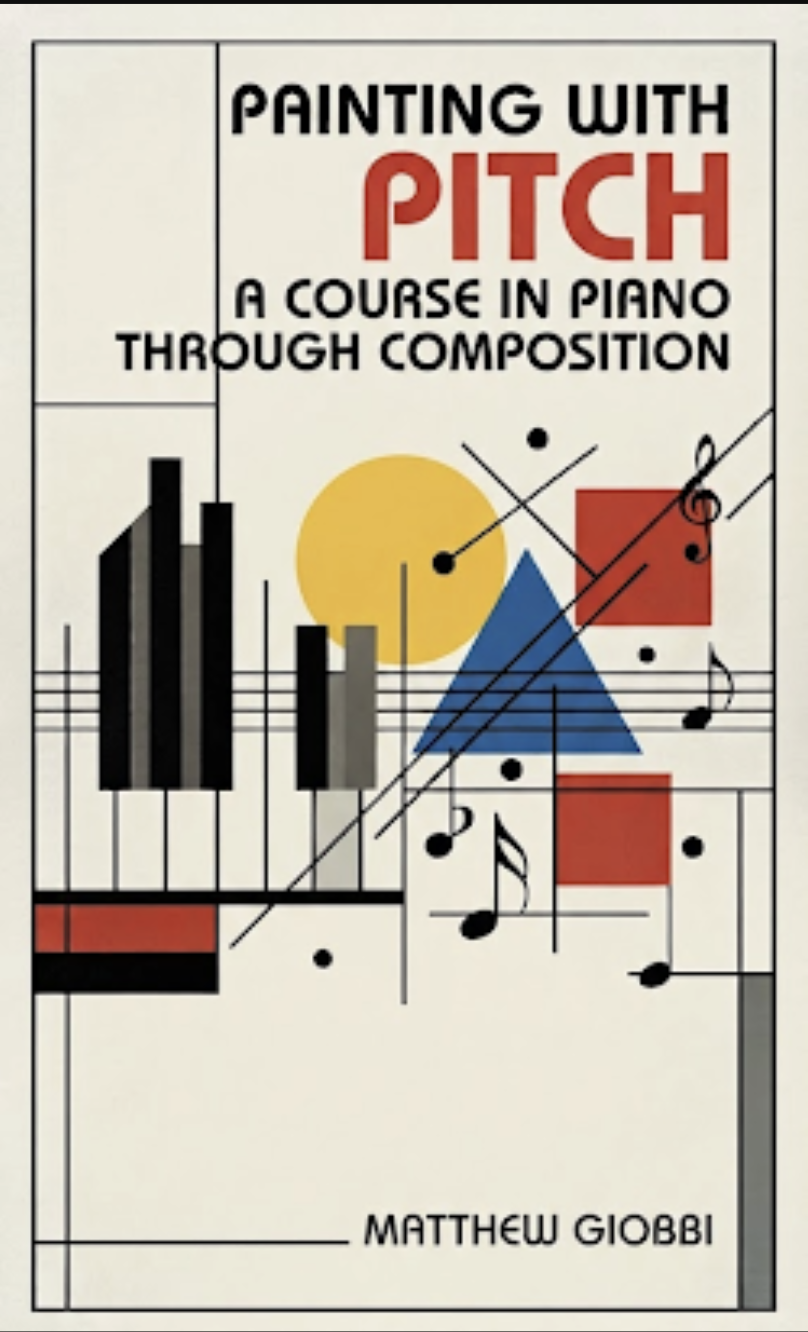
Painting With Pitch: Discover the Piano as an Instrument of Creativity
What if learning to play the piano were not simply about reproducing music, but about discovering how to create it?
Imagine approaching the piano not as a student trying to master a collection of difficult pieces, but as an artist standing before a blank canvas. The keys become your palette. Notes become colors. Rhythm creates movement. Harmony establishes depth, tension, and resolution. And gradually, through experimentation and discovery, you begin to develop your own musical voice.
This is the inspiration behind Painting With Pitch: A Course in Piano Through Composition, an approach to learning piano that invites you to become not only a performer, but also a composer.
Learn music by creating music
Traditional piano instruction often begins with the music of other composers. Students learn to read notation, practice exercises, and reproduce pieces as accurately as possible. These are valuable skills, but there is another way to approach the instrument: begin with the creative act itself.
What happens when you place two notes together? How does a melody change when you alter its rhythm? Why does one chord seem to create a feeling of rest while another invites movement? What happens when you abandon familiar harmonic patterns and explore unfamiliar musical possibilities?
These questions transform piano study into an adventure.
In Painting With Pitch, the student explores the fundamental elements of music by composing. Reading, technique, ear training, theory, analysis, and performance are integrated into a creative process. Instead of treating musical knowledge as a collection of facts to memorize, the course encourages students to discover how musical ideas work by putting them into practice.
The goal is not simply to learn about music. It is to learn to think musically.
The piano as a canvas
A painter learns about color by mixing pigments, observing contrasts, and experimenting with the relationships between shapes. A musician can approach sound in much the same way.
A major scale offers one kind of musical landscape; a minor scale offers another. A chromatic interval can introduce surprise or ambiguity. A modal progression can open a space that feels suspended outside the familiar pull of conventional harmony. Rhythm can make a simple musical idea feel playful, meditative, dramatic, or expansive.
Through composition, these possibilities become experiences rather than abstractions.
You might begin with a few notes, arrange them into a small melodic figure, and discover a rhythm that gives them life. You might place a melody over different chords and notice how its emotional character changes. You might experiment with major and minor modes, explore modulation, or create a piece using principles of counterpoint.
There is no need to begin with a masterpiece. The important thing is to begin creating.
Each small experiment develops musical understanding while encouraging curiosity, imagination, and independence.
From musical foundations to improvisation
Painting With Pitch offers a systematic journey through the language of music. Its lessons explore the architecture of the keyboard and the hands, the nature of music, rhythm, intervals, scales, harmony, phrasing, modulation, modes, musical form, and counterpoint.
The course also ventures into improvisation, composition software, the study of other composers' music, and Gestalt visual thinking as a way of understanding musical composition.
These subjects are connected by a common principle: musical knowledge becomes more meaningful when you use it to make something of your own.
Learning harmony, for example, becomes more than identifying chords on a page. You begin to hear the possibilities contained within them. Studying form becomes more than memorizing formal structures. You discover how musical ideas can develop, contrast, return, and transform. Learning to improvise becomes an opportunity to bring your understanding of rhythm, melody, harmony, and expression together in the present moment.
The result is a more integrated relationship with music—one in which thinking, listening, feeling, and creating work together.
Creativity is not reserved for a select few
Many people believe that composition belongs to a special class of musicians: the gifted, the formally trained, or those who somehow possess an innate ability to invent melodies.
But creativity can also be understood as a practice. It grows through attention, experimentation, reflection, and the willingness to explore possibilities without knowing exactly where they will lead.
You do not need to wait until you have mastered every scale or learned hundreds of pieces before you begin composing. You can start with what you know, however little that may be.
A single note can become a musical idea. Two notes can create a relationship. A simple pattern can become a phrase. A phrase can develop into a piece.
The process is both educational and personal. As you learn to make musical decisions, you also develop confidence in your capacity to explore, make mistakes, recognize possibilities, and discover solutions.
This is one of the central motivations behind Painting With Pitch: to place creativity at the heart of musical education rather than treating it as an optional activity reserved for advanced students.
Learn at the pace of discovery
Music cannot always be understood on a fixed schedule. One idea may become clear in a single afternoon; another may require days or weeks of playing, listening, and reflection.
For this reason, the course is designed to be explored at the student's own pace. It can be used for independent study or as a systematic resource for piano teachers who want to incorporate composition into their teaching.
Self-study offers the freedom to linger over a musical question, repeat an experiment, and follow an unexpected discovery. Working with a teacher can provide additional guidance, feedback, and encouragement.
Whichever path you choose, the invitation is the same: approach the piano with curiosity and allow the process of creating music to guide your learning.
A different relationship with the instrument
The piano can be much more than a machine for reproducing written notes. It can become a place to investigate sound, develop ideas, explore emotion, and discover new ways of thinking.
When you compose, you begin to listen differently. You notice relationships between notes, the character of different harmonies, the shape of phrases, and the expressive possibilities of silence. You begin to understand music from the inside—not only as something created by others, but as a living language in which you can participate.
And perhaps most importantly, you give yourself permission to experiment.
You do not have to be a professional composer to enjoy composing. You do not have to be an advanced pianist to begin exploring musical ideas. You need only a willingness to sit at the instrument, listen attentively, and discover what happens when you begin to create.
The piano becomes your canvas. Sound becomes your medium. Music becomes a practice of discovery.
Begin your creative journey
Painting With Pitch: A Course in Piano Through Composition is an evolving educational project developed through decades of piano teaching. Its purpose is to bring together the practical skills of piano study with the imaginative possibilities of composition, offering a fresh perspective on what it means to learn music.
If you are a beginning pianist, an experienced player looking for a more creative approach, or a music teacher interested in bringing composition into your lessons, you are invited to explore the course.
You don't have to wait until you know everything about music to begin creating it. Start with a note. Add another. Listen. Experiment. Discover.
Let the piano become a place where you learn not only to play music, but to imagine it.
Explore Painting With Pitch: A Course in Piano Through Composition at Muse & Psyche.
Develop your musical imagination. Discover the art of thinking in sound.